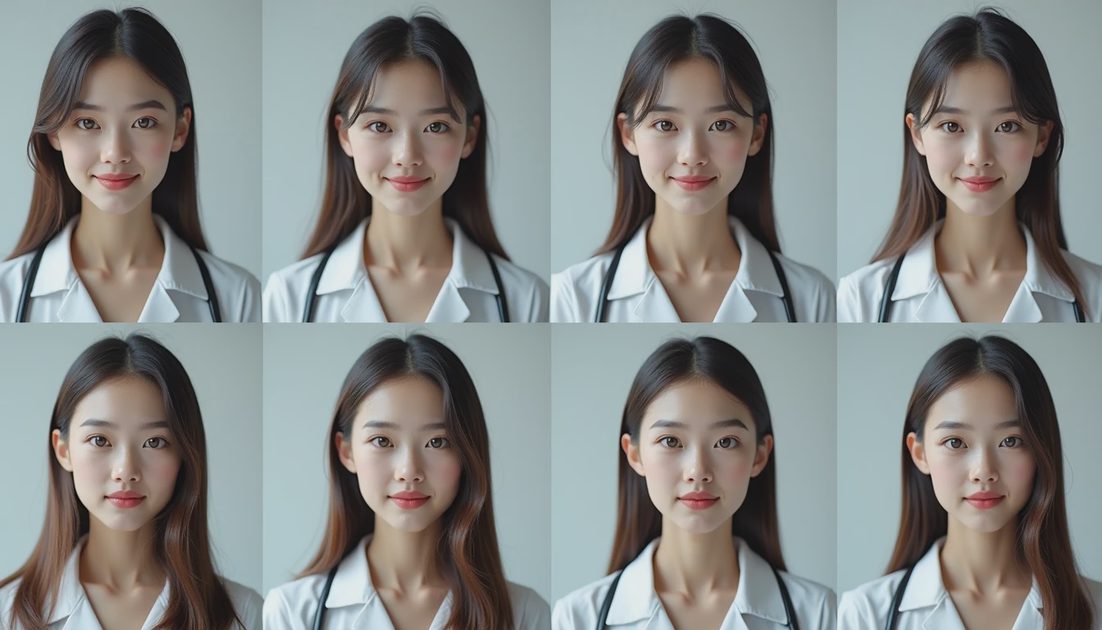
Last winter a client sent me three “consistent” character sheets generated with MiniMax H3 Turbo. The faces looked related until I locked the seed and changed only the jacket color. Two of the three drifted into different age ranges. The third kept the face but lost the scar that was supposed to be the character’s signature. That single afternoon is why I stopped treating character consistency as a vibe and started treating it as a measured workflow.
This is the sequence I now run every time someone asks for a character that has to hold across outfits, framing, and lighting. It is not magic. It is a series of forced checkpoints that make drift visible before anyone falls in love with a lucky frame.
How the Workflow Actually Starts
I refuse to open the model until an identity card exists on paper or in a plain-text file. The card is deliberately short—five to eight non-negotiable traits. Anything not on the card is allowed to vary. Anything on the card that drifts is an automatic fail, even if the image looks beautiful.
Typical card fields look like this:
Face shape and age band
Hair length, color, and silhouette
One or two permanent markers (scar, mole pattern, glasses shape)
Default expression range
Body proportions that matter for full-body shots
Once the card is frozen, I run a pure base-model baseline with a locked identity prompt and no LoRA. If the base model already holds the traits across three seeds and two camera distances, I may never train a character LoRA at all. That decision alone has saved me more training runs than any clever ranking schedule.
The Probe Set That Actually Catches Drift
A single heroic grid is marketing. A probe set is the real test. Mine always contains:
Same face, three different wardrobe blocks
Same face, tight portrait vs. medium shot vs. full body
Same face, indoor soft light vs. hard outdoor light
Same face, neutral expression vs. the character’s “signature” expression
I score each cell against the identity card, not against my subjective taste. Pass rate under 70 % means the recipe is not ready. I do not average the scores or grade on a curve.
Probe dimension | What I change | Automatic fail condition |
|---|---|---|
Wardrobe | Jacket, shirt, or accessory only | Face age or marker drifts |
Framing | Crop from close-up to full body | Proportions or face shape collapse |
Lighting | Soft indoor to hard sun | Marker disappears or skin tone shifts outside character range |
Expression | Neutral to signature | Structural face traits change |
When a Character LoRA Enters the Picture
Only after the baseline fails do I train a small character LoRA. Dataset rules are strict: every training image must already satisfy the identity card under the same lighting and camera distance I plan to use at inference. I do not include “artistic” variations that break the card. Those belong in a style LoRA, not the character one.
Training itself is short and watched. I stop at the first checkpoint where the probe set clears and the out-of-distribution prompts still look like the same person. Longer training has never helped me; it usually teaches the model the exact training outfits and kills generalization.
Logging the Recipe So Someone Else Can Run It
The final artifact is a one-page recipe card:
Identity card text
Exact base model version and host
LoRA weight and trigger (if any)
Locked identity prompt block
Variable blocks for wardrobe and scene
Probe-set pass rate and date
Hardware and approximate cost per 10 images
If the card cannot be handed to another operator and produce a recognizable version of the character, the workflow is incomplete. That is the only definition of “repeatable” I accept.
What Still Breaks Even When You Follow the Steps
Extreme profile angles, heavy stylization prompts, and sudden changes in body proportion requests still produce drift. I log those as known limitations instead of pretending the workflow is universal. Clients get the limitation list before they get the pretty grids.
A second common break point is version drift. A model host update or a silent change in the default sampler can move the same identity prompt into a slightly different face family. That is why every recipe card records the exact model hash and host string. When those change, the probe set is re-run before any production use. Skipping that re-probe is the fastest way to discover, too late, that last month’s “reliable” character has quietly aged five years.
A Real Probe-Set Failure That Taught Me the Order
Early on I trained a character LoRA first and only later built the probe set. The training grids looked excellent. The probe set later showed that the model had locked the training wardrobe so tightly that any new jacket color shifted the jawline. Had I run the baseline and the probe set before training, I would have seen that the base model already held the face shape and that the LoRA was unnecessary—or at least that the dataset needed more wardrobe diversity. The order of operations is not bureaucracy; it is the difference between measuring the right variable and measuring noise.
Timing and Cost Notes for a Small Series
For a six-image character series I now budget roughly 40 minutes of pure generation and scoring time once the recipe card exists, plus another 20 minutes if a model update forces a re-probe. Training a new character LoRA, when it is truly required, adds 1–3 hours of wall time on my current host and a few dollars in compute. Those numbers are logged on the recipe card so a client or collaborator can decide whether the consistency is worth the recurring cost. A workflow that cannot be costed is not yet a workflow.
Run the test. Save the settings. Show the failure. Character consistency is not a feature you turn on. It is a discipline you keep measuring.
No comments yet.