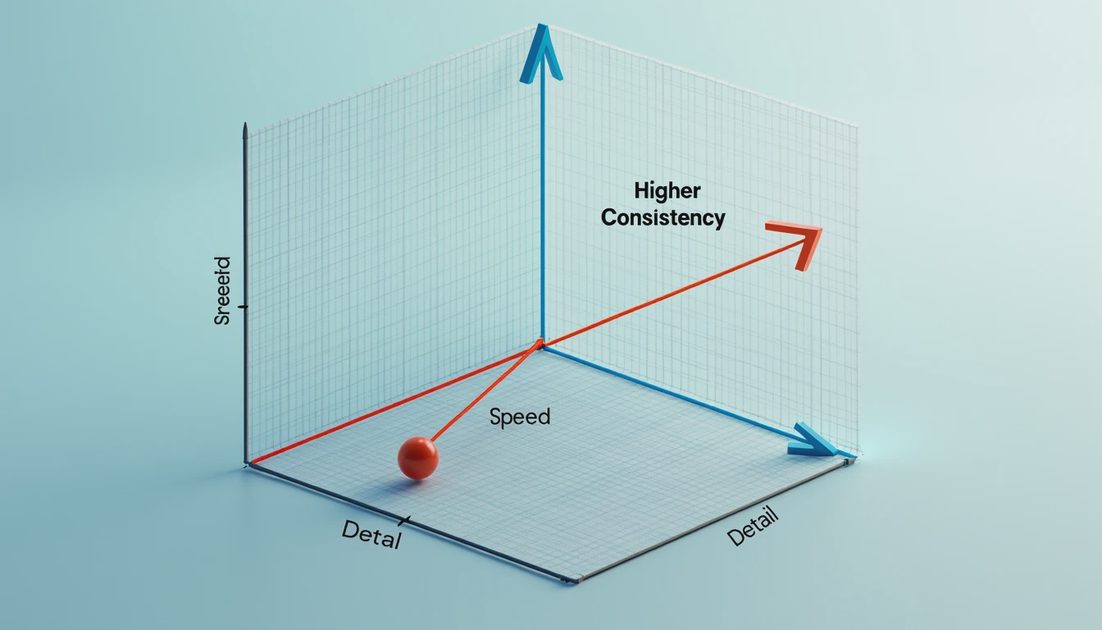
Every MiniMax H3 Turbo configuration sits somewhere on a three-axis trade-off: how fast it runs, how much fine detail it retains, and how consistently it holds identity and lighting across seeds. You cannot maximize all three at once. This bench records what the numbers actually look like and the decision rule I use when a client or a deadline forces a choice.
Hypothesis and Method
Hypothesis: For any repeatable recipe intended for more than a single hero image, consistency should outrank both speed and peak detail. Detail-first settings will produce higher individual scores but lower usable range. Speed-first settings will sacrifice either consistency or detail in ways that become expensive under iteration.
Method: I locked a twelve-image probe set (six identity-critical, six attribute-change). I ran three configurations against the same probe:
Consistency-biased: moderate strength, structured prompt blocks, slightly higher step count
Detail-biased: higher strength, denser positive descriptors, lower CFG variation
Speed-biased: lower step count, simpler prompt, aggressive scheduler
Each configuration was scored on three axes after the full probe:
Consistency – percentage of cells that retained locked identity and lighting traits
Detail – checklist score for fine structure (pores, fabric weave, edge clarity)
Speed – wall-clock time for the twelve-image set

Results
Configuration | Consistency pass rate | Detail checklist score | Time for 12 images | Usable range note |
|---|---|---|---|---|
Consistency-biased | 11/12 | Medium | Baseline +18 % | Wide strength band |
Detail-biased | 7/12 | High | Baseline +35 % | Narrow, drifts outside training look |
Speed-biased | 9/12 | Low–Medium | Baseline –40 % | Acceptable for exploration only |
The consistency-biased settings produced the only configuration that cleared the probe set at a rate I would trust for client work. The detail-biased settings generated two frames that were visibly richer; the other ten contained identity or lighting failures that would have required re-rolls. The speed-biased settings were fine for mood boards and early exploration; they were not fine for anything that had to match across a series.
Analysis and Decision Rule
Faster hardware shifts the raw numbers but rarely changes the ranking of priorities. A quicker host makes the consistency-biased settings more tolerable; it does not make detail-biased settings suddenly consistent. I re-measure after major host or model changes, but the decision rule itself has stayed stable:
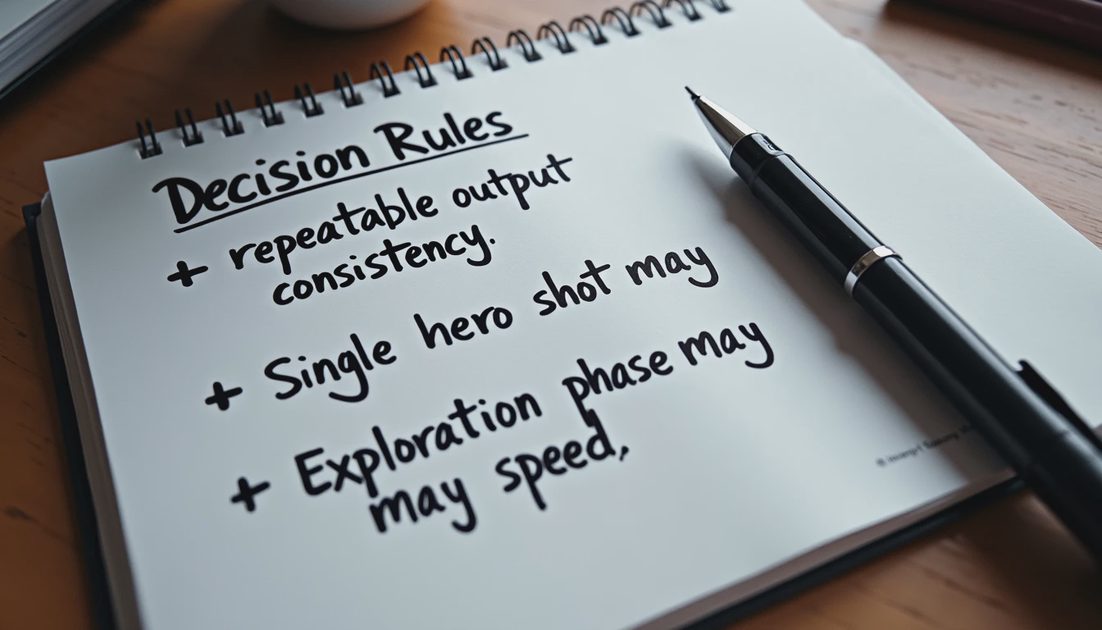
If the output must be repeated or handed off, consistency is the primary axis.
If the output is a true one-shot hero and variance is acceptable, detail may lead.
Speed is a secondary axis that is allowed to lose unless the use case is pure exploration.
I no longer publish configurations labeled “balanced.” Early attempts at balanced settings were merely mediocre at each axis and fragile under stress. Every published recipe now states its priority order explicitly. If a client needs two different priorities, they get two different recipes.
A Recent Application of the Rule
A six-frame character series was required for a short presentation. Detail-first settings produced two strong frames and four that drifted. Consistency-first settings produced six solid, slightly softer frames. We shipped the consistency set. The client later requested three additional matching frames under a new wardrobe. The consistency recipe made that request cheap. The detail recipe would have made it expensive again.
Trying to optimize speed, detail, and consistency simultaneously usually produces a fragile middle that is mediocre at everything. I would rather publish two specialized recipes—one fast-and-consistent, one detailed-and-slow—than one that claims to do all three and fails the first real stress test.
Run the test. Save the settings. Show the failure. The trade-off is not a temporary inconvenience. It is the permanent shape of the work.
I now present the three-axis table from the latest bench to clients instead of promising a configuration that is fast and sharp and consistent. Most clients, once they see the numbers, choose consistency and accept slightly softer detail or longer runtimes. The conversation is shorter and the final recipe is more honest. Occasional one-shot hero deliverables still use detail-first settings; those settings are logged as single-use and never migrate onto the shared shelf.
Re-measurement after model or host updates remains mandatory. The absolute scores change; the relative ranking of the three priorities has so far remained stable. That stability is why the decision rule itself has not needed rewriting. The rule is simple enough to remember under deadline pressure, which is the only condition that actually matters.
The measurement method itself is deliberately lightweight so that it actually gets repeated. A twelve-image probe is enough to expose large differences between configurations. Longer probes add precision but rarely change the ranking. I would rather run a short probe every time a setting changes than run a long probe once and then guess for the next three months. The bench exists to make the trade-off visible, not to produce a single permanent ranking that never needs revisiting.
When a new model version arrives I re-run the same three configurations on the same probe set before updating any published recipe. The process takes under an hour on the current host and has repeatedly prevented the quiet migration of detail-biased settings into recipes that were originally consistency-first. That quiet migration is the most common way a once-reliable workflow becomes unreliable without anyone noticing.
No comments yet.