
I used to believe longer prompts were simply better. More words meant more control. Then I ran a controlled comparison on MiniMax H3 Turbo with the same subject, the same seed family, and three prompt styles: short (under 30 tokens), long (150+ tokens of continuous description), and structured blocks (identity / wardrobe / scene / camera separated by clear delimiters). The results changed how I write every prompt now.
This H3 Bench post records the exact test, the scoring method, and the practical recommendation that survived the data.
The Test Design
Subject: a 30-year-old woman with a specific face shape, chin-length dark hair, and a small scar above the left brow.
Fixed variables: model version, host, seed set of ten, resolution, sampler.
Variable: prompt construction method only.
I generated ten images per prompt style and scored them on four axes:
Identity lock (does the face and marker hold)
Prompt obedience (does wardrobe and scene match the request)
Visual coherence (no conflicting lighting or anatomy)
Usability for iteration (can I change one block without breaking others)
What the Short Prompts Actually Did
Short prompts produced the highest visual coherence and the fastest iteration speed. Identity held reasonably well when the subject was simple. The moment I asked for a specific jacket color plus a background plus a camera angle, the model started dropping pieces. Short prompts are excellent for exploration and terrible for precise multi-attribute control.
What the Long Continuous Prompts Produced
Long prompts improved obedience on the first generation. They also introduced new failure modes: the model would latch onto early tokens and ignore later ones, or it would blend conflicting descriptors into a muddy average. Changing one detail required rewriting the entire paragraph, which made controlled experiments painful. Long prompts felt powerful until I needed to isolate a single variable.
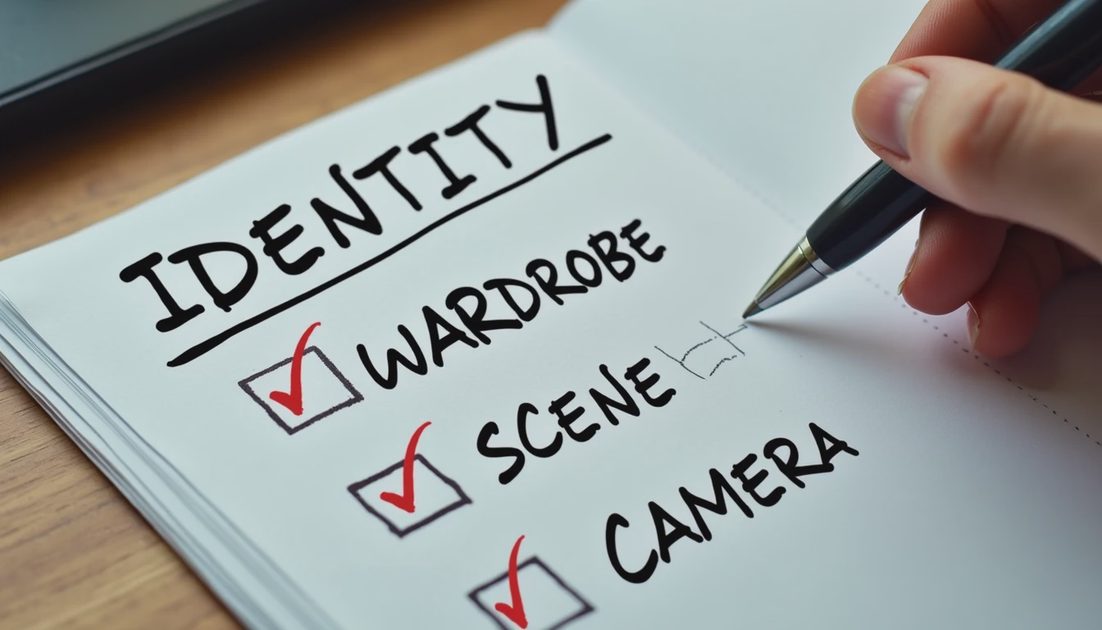
Structured Blocks Changed the Game
I split the prompt into four labeled blocks:
IDENTITY: [locked face and marker description]
WARDROBE: [current clothing only]
SCENE: [background and lighting only]
CAMERA: [framing and lens only]
The same model suddenly behaved like a modular system. I could swap the wardrobe block and keep identity stable. I could change camera distance without rewriting the face. Identity lock scores rose, and iteration time dropped because I no longer risked breaking an unrelated clause.
Prompt style | Identity lock | Prompt obedience | Coherence | Iteration speed | Preferred use case |
|---|---|---|---|---|---|
Short (<30 tokens) | Medium | Low–Medium | High | Fastest | Exploration, mood boards |
Long continuous | Medium–High | High on first try | Medium | Slow | One-shot detailed scenes |
Structured blocks | High | High | High | Fast | Production recipes, team handoff |
Practical Rules That Came Out of the Bench
Use short prompts when you are still deciding what the image should be.
Switch to structured blocks the moment you need to preserve identity or run controlled comparisons.
Keep long continuous prompts for rare cases where the aesthetic depends on dense, interwoven language and you do not need to iterate attributes independently.
Always log the exact block version with the seed and model hash. A structured prompt without a log is still folklore.
The structured approach also made the signature phrase easier to live by. When a block fails, I can show exactly which block failed and what I changed next. Run the test. Save the settings. Show the failure. Prompt style is no longer a matter of taste; it is a measured trade-off.
When Structured Blocks Still Fail
Extreme style transfers and heavy artistic modifiers can still overwhelm the identity block. In those cases I temporarily lower the artistic weight or move the style into a separate LoRA rather than stuffing it into the scene block. The structure does not eliminate every failure mode; it makes the failure mode legible.
A Concrete Example From Last Month
I needed a character to appear in five different city environments while keeping the same face, hair, and scar. Short prompts produced coherent single images but lost the scar in three of the five cities. Long continuous prompts kept the scar but started blending city lighting into the skin tone. Structured blocks let me lock IDENTITY and CAMERA, swap only the SCENE block, and clear the full probe set on the second attempt. The log showed exactly which city description had been too aggressive; I softened one clause and the run passed. That level of isolatable failure is why I now default to blocks for any multi-attribute work.
Logging Format I Reuse
Every structured prompt experiment is logged with:
Block version hash or date stamp
Which blocks were locked vs. variable
Seed list
Pass/fail per probe dimension
One-sentence note on the first failure mode observed
The format takes under two minutes and has repeatedly turned “it felt better” into a reproducible claim.
Scoring Axes I Actually Use
I score every style on four axes after a fixed probe set of twelve images:
Identity lock – does the face or object stay recognizably the same person/thing across wardrobe and lighting changes?
Attribute obedience – does each requested change (color, pose, time of day) actually appear?
Coherence – does the image remain free of obvious anatomical or lighting contradictions?
Iteration speed – how many minutes does it take to isolate and fix one failing attribute?
Structured blocks win on axes 1, 2, and 4 for any multi-attribute job. Short prompts win on axis 3 when the goal is a single exploratory image. Long continuous prompts rarely win any axis once the probe set grows beyond six cells. Those numbers are what moved me from “I like long prompts” to “I use long prompts only when the aesthetic depends on dense interwoven language and I do not need to iterate.”
A Second Failure Mode Worth Naming
Even structured blocks can hide a quiet problem: block bleed. If the SCENE block contains a strong identity-related phrase (“the same scarred woman from the identity card”), the model sometimes treats that phrase as higher priority than the dedicated IDENTITY block. I now keep identity language strictly inside the IDENTITY block and treat any leakage as a prompt bug. Logging the exact text of each block makes that bug visible on the next review.
Run the test. Save the settings. Show the failure. Prompt style is a measured trade-off, not a personal aesthetic preference.
No comments yet.